Wednesday, February 11, 2009

Winter herpin' with the Dobbs boys

Rob was in town briefly (from Colorado for those who don't know), and as usual....herps were a must while he was in town. We went out one night (myself, Rob & Chris Dobbs) specifically for photographing singing Pseudacris. Rob was also aiming high, wanting to photograph Southern leopard frogs, Lithobates spenocephalus singing......HAH.......good luck!

Below are the night's highlight shots.....I want everyone to notice....there are NO...pictures of spenocephalus singing..........................I......TOLD........YOU........SO!!!!! Aww, it's all in good fun anyhow........


singing male spring peeper, Pseudacris crucifer (above)


singing male Cajun chorus frog, Pseudacris fouquettei (above)


Chris Dobbs here....appearing to be under the influence......but we don't roll that way! Just a goofy shot!

Monday, March 03, 2008

Late Winter Summary, part 1

Things have been real busy in the Basin lately. It’s been a while since I posted here, but the work that’s being done is down right awesome! Dr. Hardin Waddle, Tyler Thigpen and I have been conducting visual encounter surveys in the Basin at night, usually three to four nights a week. When we encounter a herp, we (when possible) measure, age, sex and look for abnormalities. We also gather data for average wind speed (mph), air temperature in °C, relative humidity and substrate the animal was using. I could sit here and type for hours with the experiences we’ve been fortunate enough to have, but I’ll try and summarize with a collection of photos from the field. We’ve seen a great many things worthy of posting…..so I’ll try and break it down into parts. I should also note the central newt, Notopthalmus viridescens louisianensis that was found by Scott Hunnicutt in Plaquemine. We also tallied a newt, but it swam away before we could get pictures. -James

central newt, Notopthalmus viridescens louisianensis:


spring peeper, Pseudacris crucifer:


Cajun chorus frog, Pseudacris fouquettei:


Cope's gray treefrog, Hyla chrysoscelis:


green treefrog, Hyla cinerea:


Thursday, December 20, 2007

Herping Saturday 15 Dec 07


(Southern copperhead)

Bert Lucas and I spent much of the day herping in the Basin, mostly around Whiskey Bay, Butte La Rose & Indian Bayou. The best herps were a nice Southern copperhead, Agkistrodon c. contortrix and a ring-necked snake, Diadophis punctatus. Walking around Jim Delahoussaye's property in Butte La Rose, we picked up Cope's gray, Hyla chrysoscelis & squirrel, H. squirella treefrogs in his bird houses. The afternoon in Indian Bayou was pretty slow with mostly Coastal Plains, Bufo nebulifer & Eastern narrow-mouthed toads, Gastrophryne carolinensis.


(ring-necked snake)


(ring-necked snake)


(Cope's gray treefrog)


(Cope's gray on left, squirrel on right)


(Eastern narrow-mouthed toad)

Wednesday, November 28, 2007

Basin Herpin' 27 Nov '07

Rob Dobbs and I spent a couple of hours in the Basin last night, mostly to photograph and re-release a Louisiana milksnake he had found there Sunday night. Of course, we were also there to see what else we could find before (and just after) dark! Below are two of my best pics of the milksnake, Lampropeltis triangulum amaura. (photos by Beck)


We also scored huge with very cooperative upland chorus frogs, Pseudacris ferarium (top) & spring peepers, P. crucifer (bottom)!


After a little more poking around, we found a nice five-lined skink, Eumeces fasciatus and three (3) Eastern narrow-mouthed toads, Gastrophryne carolinensis.


Friday, March 30, 2007

Cottonmouths

Well, I already have a post devoted to copperheads...I might as well have one for cottonmouths as well. A.K.A. "water mocassins", they are another pit viper closely related to copperheads. The subspecies we have here in Louisiana is Western cottonmouth, Agkistrodon piscivorous. Like their copperhead cousins, they are live-bearers and are born with yellow tips to the tail, to lure potential prey items within striking distance. They're also heavily banded when they're young (picture at end of post). While we're on the subject of snake tails, I want you to notice the drastic truncation at the base of the tail of the below pictured cottonmouth:


This is indicative of a female. The tails of males would taper off much more gradually in shape towards the tip, as they need more room to store the hemipenes.

Cottonmouths are, naturally, venomous and get their name from the light-colored lining in the interior of the mouth. There are numerous species of watersnakes (genus Nerodia), which mimic cottonmouths, but are non-venomous. Below is a picture of a banded watersnake, N. fasciata.


Countless watersnakes are killed each year when people whom are less informed take the snakes' lives often to protect their family from a potential threat of a venomous snake. But...let's not kid ourselves, not everyone who kills a snake is rationally-minded. In fact, some kill snakes because it makes them feel "manly". Wow...please excuse my lack of enthusiasm for someone who is successful in killing something much smaller than themselves and perhaps because they're insecure about themselves.......

Anyway... Cottonmouths, as their specific name (piscivorous) implies, eat fish. Not soley, but they do consume fish and can consume fish as large as bream and small catfish. They also will prey on frogs, lizards, etc. Some can attain lengths of near 5' or so, but this is quite rare. Most are smaller, and individuals of 2-3' are more often encountered. Below is a juvenile snake I caught at the Zoo of Acadiana in Broussard a few years ago.


Monday, January 29, 2007

Northeast Louisiana Plants

Not much to ramble on about here, but included are some images of some of the plant species myself, Bobby Keeland, John McCoy and Erika Stelzer sampled while working in the Tensas River Basin. I took pictures mostly of trees, shrubs & vines that I would like to learn better.

Carolina snailseed (Cocculus carolinus):


Climbing dogbane (Trachelospermum difforme):


Smilax bona-nox:


Poison Ivy (Toxicodendron radicans):

The Rattlers of Canebrake

It's been a while since we've had a post on this blog. To tell the truth, I forgot my username and/or password. You know how that goes, you try a thousand different combinations, and nothing works. Then finally, you find where you put it so that you could "find it" if you were ever to forget it. Right....

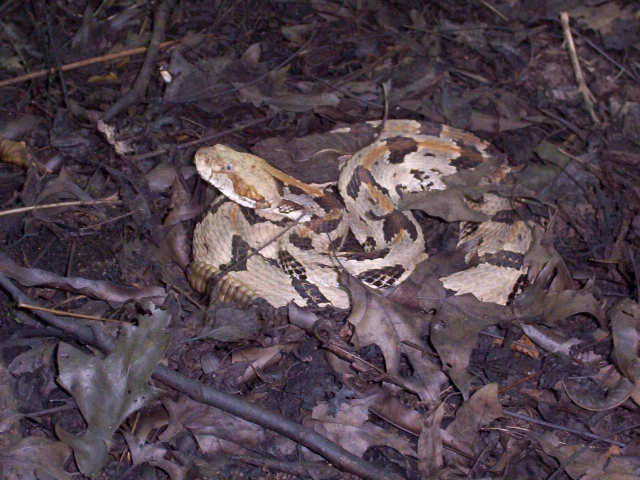
Anyway, enough about that. This past summer I did a lot of field work up in the Tensas River Basin as well as the White and Cache River Basins of Arkansas. The work was centered around the amphibian research we had been working on, but also now there was a new phase: plants. I got to work with Dr. Bobby Keeland and John McCoy in the field on the plant project. I'll get to that in a minute. First thing's first. While working out in the Buckhorn WMA in Tensas Parish, Susan Walls and I finally stumbled upon what we were really hoping to find while working up there....the mighty CANEBRAKE RATTLESNAKE.


It's pretty funny how we came across the first one, actually. I was leading the way via GPS to one of our frogloggers, deep in the thick, palmetto-covered undergrowth of the forest. I happened to trip over some exposed roots, and landed palms-first on a spread of blackberry (Rubus sp.). Now, previous to this, Susan had been stung four times already by yellowjackets (Vespula sp.)! So, candidly, I told her that I had thorns in my fingertips to make up for not being stung. Just then, I caught a glimpse of something moving on the forest floor right next to where I stood. When my eyes adjusted to the low light, there was a very large canebrake rattlesnake (Crotalus horridus)! The snake was at least 5' in length, and had an impressive girth. The pictures do the snake NO justice. The conditions were such that a "perfect" picture was not attainable without further agitating the snake. As it was, the snake showed no signs of aggression...no rattling. But, we didn't want to take any uneccessary chances way out here. Plus...one of us (hint, NOT Susan) has been bit by this species before, and not looking for a rematch. The snake we found is illustrated below.


Unbelievably, about 20 minutes after finding this first rattler, I found another one! Susan didn't believe me at first. Only after seeing me taking a picture of something did she come over for a look. This individual was smaller, and thinner than the first, but the picture came out better of this one....figures.

It's been a long time now since I've been up in Tensas. I look to be back up there again the last week of February. It might be too cold for most snakes then, but I'll be constantly be looking...for the rattlers of the canebrake.

Friday, April 28, 2006

Tensas River Basin

We spent the week of 4/17 – 4/21 working based out of Tallulah, Madison Parish. Madison Parish is located in extreme northeast Louisiana, one parish south of the Arkansas border. We were working in the Tensas River Basin, setting out frogloggers in various locations. Even this far north, migration was quite apparent. The bulk of the migrants were Orchard Orioles, but we had a decent selection of other migrants as well. In the cotton fields of Winnsboro, it was a real treat to see Horned Larks on their breeding grounds; something I’ve never witnessed in Louisiana. I have seen them on breeding territory in New Mexico. Also in Winnsboro, Susan Walls and I came across a very large cottonmouth hunting a ditch for frogs. At this site we heard Cope’s gray treefrog, northern cricket frog, bronze frog and bullfrog.

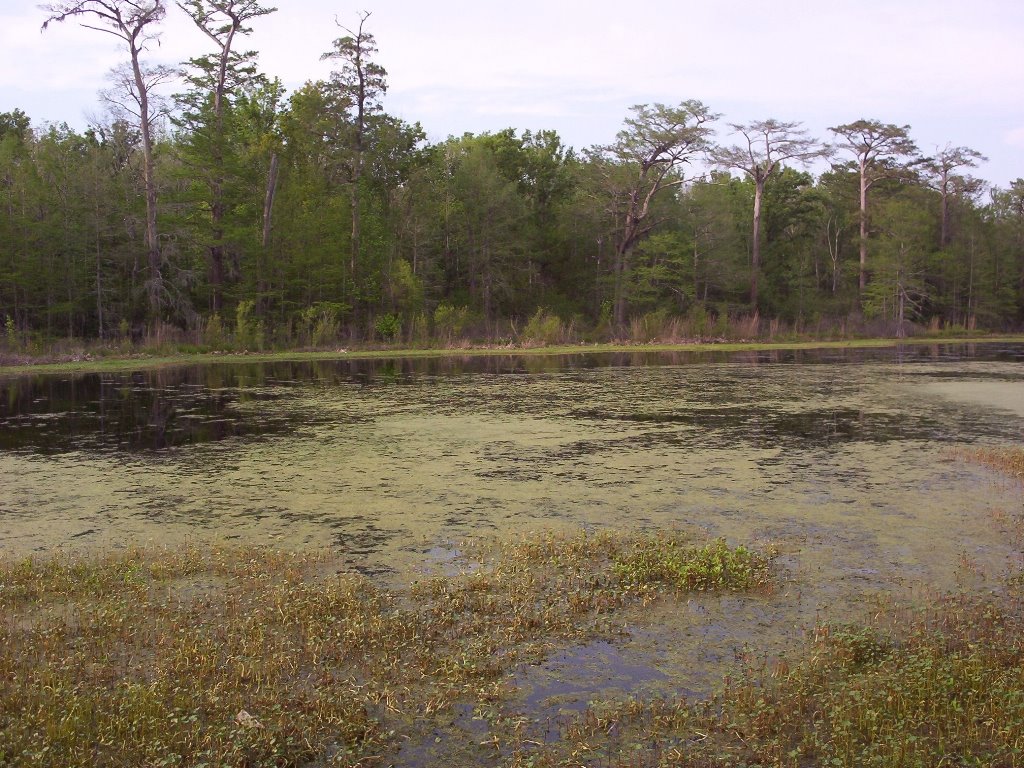
By far my favorite place we visited was the Tensas NWR. This vast expanse of hardwood bottomland is home to loads of breeding birds and interesting insects, but also home to another population of Black Bears. Susan, Mike Baldwin and I got to see a bear on Thursday, as we were riding into one of our study site on the north end of the NWR. We rounded a corner, and after studying some scat along the road, I spotted an adult bear at the edge of a meadow full of flowering vetch. When the bear saw us coming on the four-wheeler, it took off for the forest without looking back. Samantha Hill and Chad Case had just run back to the truck to retrieve another froglogger, so unfortunately they missed the bear. Migrants here were Tennessee Warbler, Dickcissel and Blue Grosbeak. Many others were around too, but species like Yellow-billed Cuckoo, Swainson’s Warbler and Yellow-breasted Chat were likely local breeders.

My favorite experience at the refuge (besides the bear) was a full chorus of bird-voiced treefrogs (Hyla avivoca) at the big lake. (at right) Just before hearing this large chorus, I had found a ring-necked snake, but it proved to be very difficult to photograph, and consequently zero out of six pictures came out worth keeping.

Before we set up shop in Tensas NWR, we visited Buckhorn NWR. As we were unloading the ATVs, we noticed a problem with one of the trailer tires. It would turn out that Chad and I would have to bring the trailer into town to have the problem fixed. So, we missed out on setting out the frogloggers at Buckhorn, but not before I heard a Prairie Warbler singing!

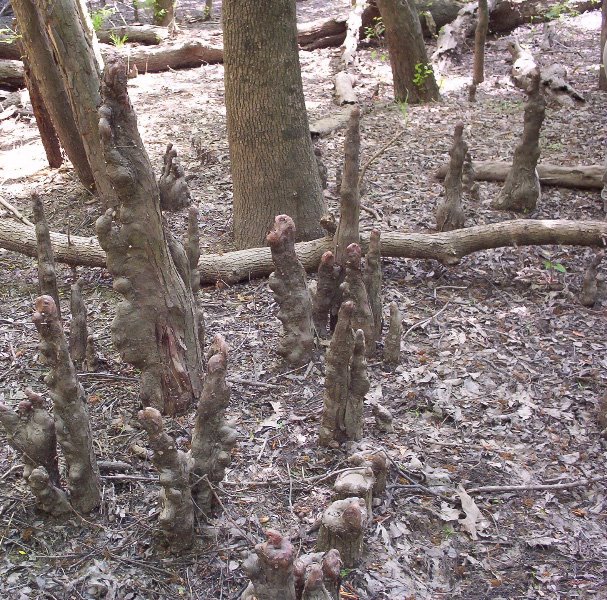
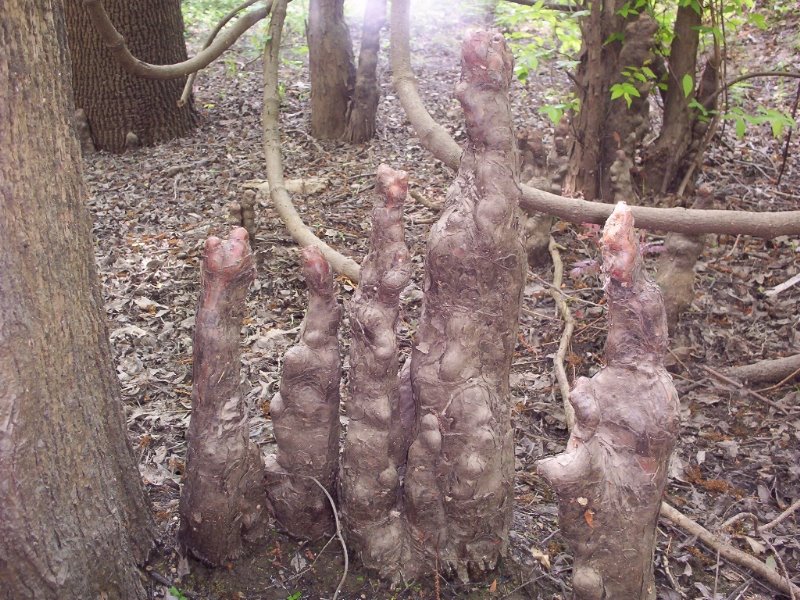
Overall, we had a great trip and saw lots of neat things. Most of the animal pictures didn’t come out worth keeping, but the scenery pictures did. I have included pictures at the end here of some of the oddly-shaped cypress knees in the swampy area on the north end of the Tensas NWR.


James

Tuesday, April 11, 2006

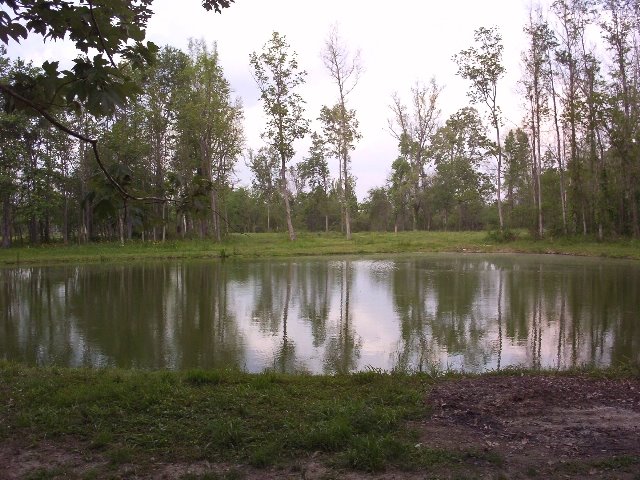
A Weekend in Washington


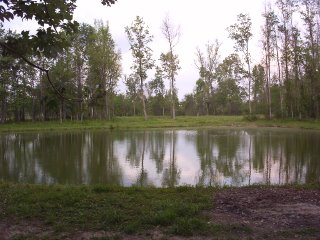
Beautiful historic Washington, LA is located in St. Landry Parish, north of Opelousas. I have a friend whose family owns a nice chunk of undeveloped land in the gorgeous hilly countryside. The habitat includes agricultural fields bordered by second-growth forest, which leads down to a man-made pond surrounded by mature hardwood bottomland. I went up Friday night with my friend Jon Colletti, planning on camping for the night and returning the next afternoon. There were lots of things to see; dragonflies were abundant, snakes, frogs, birds. While we were setting up camp, a vehicle pulled up. It was Michael Barney and Travis Huval. Steven and Michael Barney are my friends whose family owns the property. Originally local, Michael now resides in Florida, and Steven in Broussard with his wife Nikki daughter Emma. Travis Huval hails from Sunset. All the aboved mentioned are admitted bug geeks, so naturally, their company is always welcome. Jon Colletti lives in Coteau with his wife Lea and son Beau-man.
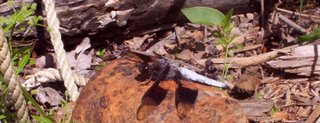
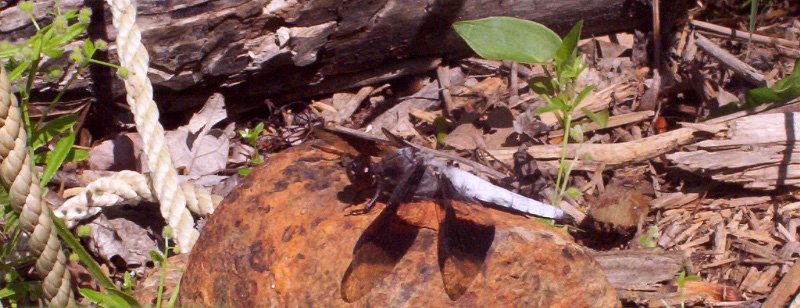
Now that everyone has been formally introduced, we can focus on the sightings/findings of the weekend. Around the pond, dragonflies ruled the air: common whitetails (above) were most abundant, with fewer numbers of eastern pondhawk, blue dasher, common green darner & black saddlebags. I did notice one female Amanda's pennant. On the first night, we found a few water scorpions and one water measurer. That night, while patrolling the edge of the pond, I found a young mud snake consuming a bullfrog tadpole in the water. I wanted to capture the snake and get measurements, but before I could even consider the snake being disrupted from its meal, it submerged-meal and all.
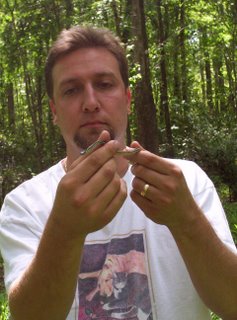
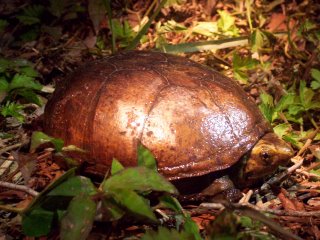
After a while of walking around flipping cover, we found a nice western ribbon snake (picture at right). There were a few bronze and leopard frogs around the bayou that splits the property, but after walking for a couple of hours, we were ready to head back to camp. Around the pond, I caught a fiesty yellow-bellied watersnake followed shortly by a banded watersnake. Steven and Michael turned up a Stinkpot, so I was able to get some decent shots of this unusual turtle. (photo below)
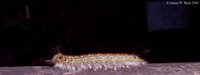
The weekend certainly belonged to the bugs. Forest tent caterpillars (see photo below) dominated the scene. They were literally falling from the trees. They covered our tent (no, that's NOT why they're called tent caterpillars...), the Jeep and just about everywhere else you looked. For those who know these little furry guys, know well that they are harmless, unless you are tree leaves. Tent caterpillars can be quite damaging to a population of tree species. They begin to emerge when fresh, green leaves start to bud out. They have been known to eat willow, oak, maple, hawthorn, ligustrum and more! Anyway, along with the caterpillars were caterpillar hunters. These large, metallic green beetles were in no way as common as the prey they seeked, but that's the way a nicely balanced ecosystem works; fewer predators than prey. I did not take any photos of these beetles, but perhaps Steven did and I might obtain a picture from him for posting purposes.
Just as the night was coming to an end, I noticed (around 1:45 a.m.) that I was missing my one and only Jeep key! Had I let Jon use it? Nope, he didn't have it. After a frantic scamper around camp, I realized I was in serious trouble. I called Steven and Michael (who had left by now) and they very graciously turned around from north Lafayette to come back and help me look the key. We looked until 3:30 a.m., and decided to call it quits and resume the search the next morning....after sunrise. Now, I already felt bad that they had to turn around to help me look for the stupid thing the night before, but now I felt really bad because they had cancelled a trip to Kisatchie they had planned to help me again. Let's put a long story in the making to rest. Case in point, we never found the key. I had to have the Jeep towed out and brought to a dealership in Opelousas so that another key could be made.
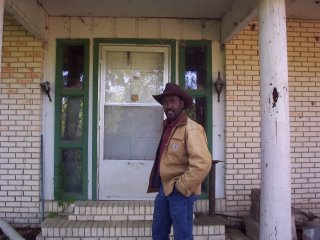
I did make a new aquaintance over the weekend; Ed Harris (at right) of Washington. He and his family live just down the road from the Barney property, and according to Ed, his land is full of snakes. Now of course, when we walked over to his property with him, we didn't find a single snake. I do believe him though...there's lots of good looking habitat and he's invited us back any time we want! Some nice folks.

Well, in closing, I suppose the best thing I experienced this weekend was the great friendship that I have. I want to thank everyone who came out and help look for my damn key, including my wife Ellen and Steven's wife Nikki.

James

Wednesday, April 05, 2006

Spring has arrived

Well, despite our lack of rain, spring has finally arrived. In the Basin, there are plenty of migrants and newly arrived local breeders. Yellow-crowned Night and Little Blue Herons are back en masse, as well as Yellow-throated, White-eyed & Red-eyed Vireos. Last week in addition to the Swallow-tailed Kites, there were tons of Prothonotary & Hooded Warblers, with also a few Yellow-throated Warblers and Louisiana Waterthrushes. This week I picked up my first Great Crested Flycatchers & Eastern Kingbirds for the year. There have been reports this week of large numbers of Buff-breasted Sandpipers SW of Maurice with smaller numbers of Upland Sandpipers. I think I'll make a run out there this afternoon to check out the shorebird situation.

As far as frogs go, Northern cricket frogs continue singing, and I heard my first bullfrog of the season yesterday while taking tree trunk measurements at the zoo.

On the bug front, June beetles (not june bugs...) have started emerging, and there are thousands flying each night at my home in Broussard. On the ponds out front of the NOAA building here next to the Wetlands Center, I caught a waterboatman (Corixa sp.), two backswimmers (Notonecta sp.) & a water scavenger beetle (Hydrophilus sp.). I brought them home, and placed in my "native Louisiana" ponds. It's a simple 3' diameter pond with Ludwigia palustris, Alternanthera philoxeroides and a couple of other native plants. I also collected a water strider (Gerris sp.) and a long-jawed orb-weaver (Tetragnatha) to place in the pond. Nice native microhabitat I've got going there.

Well, that's about it for now...more spring notes coming soon!

James

Friday, March 31, 2006

A Few Notes From the Basin 29 March 2006


Wednesday turned out to be a great day out in Whiskey Bay. I lead a snake field trip for a LSU Native Wildlife class. Since we had been told this was going to be a snake trip for a herptetology class, I was surprised to see that many of the students were carrying binoculars. After our brief introduction at 3:15 p.m., we headed down Happytown Rd., where had had some luck in the past flipping cover. It was refreshing to see the mosquitos were represented in such healthy abundance. We flipped everything in site, and only turned up a few juvenile five-lined and a couple of adult broad-headed skinks. I suppose I should also mention the couple of nice purple ground beetles we found too.

As it would turn out, the day actually belonged to the birds. Just along the levee road (north of I-10), we had three mentionable experiences. I kept seeing a large raptor soaring on long, flat wings behind the tree line. After coming around a curve in the road, the bird was now in good viewing condition. It proved to be an adult Bald Eagle, being harassed by an Osprey. Most of the students were able to see it before it disappeared again behind the tree line. About 1/2 mile further down the road, I saw more birds soaring off to the left. Three Swallow-tailed Kites with three Turkey Vultures! One of the students asked "What kind of tailed kite is it?".

Riding with me in the USGS truck was a young lady from Zimbabwe, Africa. She had been asking me about turkeys in the Basin. We knew there was a turkey hunt going on, so I wasn't surprised when the topic came up. I told her that I had never seen turkeys in the Basin and that I probably hadn't seen a turkey in the wild in ten years or so. Before we could say anything else, a gobbler Wild Turkey ran acorss the road in front of us coming from the levee! I couldn't believe it!

So, even though we didn't see all that many herps, we had a great day out regardless. We did see a couple of banded watersnakes and a few of last year's alligators. We need some serious rain here in the Basin. There are places that are usually hosting standing water, that have been dry for months!

James

Monday, March 27, 2006

Small Snakes!

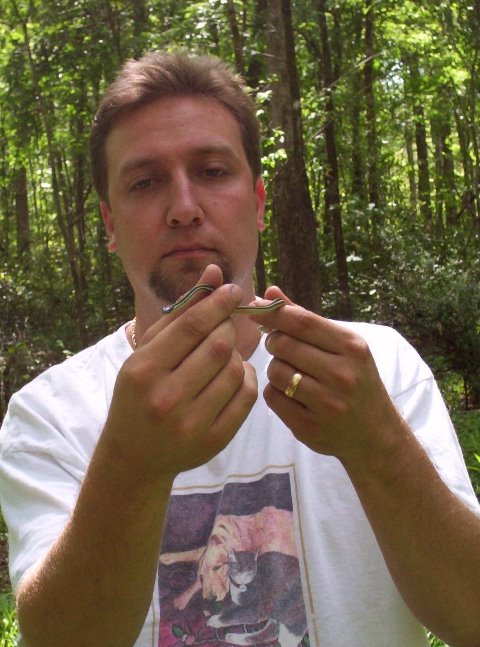
Small snakes! Boy, are they cool! I must say, a lot of my friends growing up that were into reptiles with me were not very interested in these little guys. Except one; my friend Eric Guidry. He turned me on to the small snakes by showing me pictures of ring-necked snakes (seen in picture above). I have to say, in all my years looking for amphibians and reptiles, I have only come across three of these beautiful little gems. The first time was in Pass Christian, MS at a relative of Eric's out in the country. That was 1991. It was a long time until I saw my second, which was a solo discovery in Mandeville, LA in a small woodlot near one of my uncle Scott Boudreaux's previous residences. I walked into the woodlot and immediately saw lots of boards and siding laying around. "Alright!" I thought to myself, "this place ought to be crawling with stuff" (no pun intended). The first piece of cover I flipped was an old sign, and lo and behold; there was a 3" ring-necked snake! What a beauty!!! I was so pleased with this find, that I decided to hold onto it and show it off to some friends. Oh...and for those who are wondering, I also turned up a pregnant* Eastern garter snake and several ground and five-lined skinks. *You will notice I used the term "pregnant" here because snakes of the genus Thamnophis (garter, ribbon snakes) are vivaporous, or give birth to live young. Snakes that lay eggs are referred to as oviporous, and when they are carrying eggs, are referred to as "gravid".

Anyway....that second ring-necked snake was around 1999 or so. Another dry spell passed until I found my third. That was, until the beginning of March this year. Susan Walls, Samantha Hill and I were out in the Basin surveying some of our amphibian study sites in Whiskey Bay. After determining a location to set out one of our "frogloggers" (a digital recording device), we flipped a single piece of tin, and there was a ring-necked snake! (Actually, the very one in the picture) We were psyched! We took a few pictures, and then turned the little fellow/gal free.

I've been rambling on so much about ring-necks that I almost forgot to mention some of the other small snakes we have here. One day recently while out in the yard, Ellen called to me saying, "James, there's a snake over here!". The only other snake we've had in our yard was a speckled kingsnake a few years back, so naturally that was the first thing to come to mind. However, when I got over to where she was standing, there was this small (ca. 3.5") snake in the grass. It turned out to be a red-bellied snake! My first one ever! (at right)

The very next day, I was at my friend James Reitter's house and we were flipping some rocks in the coulee behind his complex. After a bit of searching, I found a brown snake (below). This little guy was about 6" long. Most of the small snakes we have here feed on worms and small arthropods. The average adult lengths of the three small snake species I've mentioned here are as follows:

ring-necked snake Diadophis punctatus 30"
red-bellied snake Storeria occipitomaculata 16"
brown snake Storeria dekayi 20 3/4"


So, in closing, when out flipping cover looking for that "fantastic find", don't forget to look for these sometimes hard-to-find little guys of the serpent world. I think you'll be amazed how beautiful something so small can be.

James